Thursday, January 25, 2007

STUMBLING BLOCKS INTO STEPPING STONES


On last week’s Ngati Kahu radio show I interviewed Carol Hudson, Adult Community Education (ACE) Coordinator and Librarian at Taipa Area School, about how she and a number of teachers at the school want to deliver their “Stepping Stones and Pathways” to the taitamariki / young adults in their rohe. They’re especially concerned about those who are no longer at school, not yet employed in their dream job, and wanting to get some unit standards under their belt. Sadly they’ve found it hard to gauge the interest level because only two people turned up to their first informal meeting held on September 7th. So here’s me doing my bit to promote what Carol and the ACE team are trying to do in Taipa.

ACE used to be known as “night school” and, even though the name has changed, the dedication and commitment of the people who are willing to give up their time and talents to tutor others remains bright. Take a look at the following lineup of prospective tutors and courses at Taipa. They have Jo Berghan (Parenting Skills), M’am Fiona King (NCEA English), Wyane Walsh (NCEA Math), Dianne Vette-Welsh (ESOL), Jessica Lightband (Cooking on a Budget), Matua Tangira (Tu Tangata), Mark Edwards (Computing), Steve Tansey (Graphics) and Karen Gally (Budgeting). Those look like pretty useful skills for anyone to gain, let alone those who are unskilled, unemployed and wanting more out of life.

Whatever the case might be, the opportunity and challenge are there for people to get along to see Carol at the school and take a look at what’s possible. They have the keen-as tutors, they have the venues – and I’m willing to stick their neck out and bet that if you can’t get in they’ll try and get out to you. All they need now is the interest and feedback from you their community. Carol can be contacted on 4060159 ext. 220. So over to you Tokerau / Doubtless Bay.

Onto another kaupapa altogether. This week I met with Te Ohu Kai Moana’s Asset Transfer Team Manager to see how we can iron out the last few kinks standing between Ngati Kahu and our share of the 1992 Fisheries Settlement. We are not far away from getting the population-based portion of our allocation. But like Ngapuhi, Te Rarawa and many other Mandated Iwi Organisations (MIOs) we’re still some miles from getting our coastline-based portions of the assets because we have yet to fix a spot on the map defining the boundaries between us and our neighbouring iwi.

Why must iwi, who have managed for millennia to co-exist without defining where our shared interests begin and end, now have to put an “X” on a map? Because that is what is we have to do in order to get our own assets and to stop paying for their use. And because fighting against it has already cost us terribly. So that is why Ngati Kahu, in spite of the internal tussle within ourselves about doing so, is taking part in something we didn’t design, don’t like and suspect won’t deliver what we want. But after this week’s meeting I feel more hopeful that, as with most things that come our way, Ngati Kahu will turn even this stumbling block into a stepping stone.

Hei konei. Hei kona.

WORDS AND CONTEXT


It’s fascinating how words get most of their power from a context that very few of us have an inkling about. An example of that happened at the opening of the new Mangonui police station a few weeks ago. From my perspective the whole affair was strange for a bunch of reasons, not least being the relegation of Ngati Kahu kaumatua to a supporting role in their own rohe. But the strangest moment of the day for me personally came from a local VIP with whom I’ve always been reasonably friendly. After congratulating me on my recent appointment, she turned to the staunch Ngati Kahu man with me and said, “I’m so glad Anahera is on board with Ngati Kahu. Now we might have a decent relationship with you.”

I have no idea what the VIP meant to communicate but I had a very clear idea by the curl of his lip what my mate heard her say. Ask anyone who knows me, I’m not often left speechless. But the utter crassness of the moment frustrated me, and I just walked away. It’s not my style anymore to have public stoushes with VIPs, especially in a police station, but I wondered how Ngati Kahu could have a “better relationship” with someone who hadn’t a clue about our context?

Think about it. This is an iwi dealing with development pressures in our rohe like no other in Tai Tokerau. Karikari peninsula alone had a 7% population increase between 1996 and 2001 when the change for the entire Far North district was only 3.3%. And you can bet the house that the population has shot up even more sharply in 2006. The last lot of unjust land clearances in our rohe happened in the 1960s when the Hetaraka whanau were forcibly removed from their farm on what is now the fantastically popular camping ground administered by DoC at Maitai Bay. That’s in the living memory of a lot of us. Land is still being lost to rating pressures, and the Crown is still resisting the chance it has in the treaty negotiations to return or pay a fair price for what it stole from us.

The correlation between landlessness and powerlessness is our context and VIPs of varied ilk have presided over that. So to all VIPs out there – past, present and budding – no. I won’t tame this ‘stroppy’ Ngati Kahu lot and I won’t deliver them on a silver platter anywhere they don’t want to go. But I will do my very best to help you understand, if you want to, their context.

Who knows, you might come to admire this quite resilient iwi as we change our context and, in the process, you might get to have a real relationship with us.

Hei konei. Hei kona.

Thursday, January 11, 2007

RATIFICATION ROUNDUP


The Ngati Kahu constitution was ratified two weeks ago with a 97% approval vote. The results and supporting evidence have been sent to Te Ohu Kai Moana so it can release to us in the New Year our share of the fisheries settlement. The process was onerous, but the result is a great one by any standards.

MERRY MAITAI CHRISTMAS
This Christmas holiday period some of you might be thinking of heading out to Maitai Bay campgrounds for a day or two. Before you go here are some facts that will make your visit a lot more meaningful.

  1. The Hetaraka Whanau and this land belong to each other. In the 1960s they were unjustly and forcibly removed from it and their ownership rights over it were usurped by the Crown. Two years ago they moved back onto the land and the Crown finally began addressing the serious wrong it had done them. Alan Hetaraka lives there and, along with Te Runanga A Iwi O Ngati Kahu and the Department of Conservation, is building a solid partnership towards its future management and development.

  2. Respect goes a long way in Ngati Kahu. Within the Maitai Bay Reserve there are areas of high spiritual and cultural value to Te Whanau Moana, the local hapu, and the wider iwi of Ngati Kahu. Additionally the fore dunes are environmentally fragile and also need to be treated with respect. Ngati Kahu would prefer that they not be used at all due to the large number of past burials in close proximity to the beach, but we’ll be satisfied if you use existing tracks to the beaches and don’t take vehicles onto Merita Beach at all (except to launch boats at the left hand end of the beach). Foot traffic on that beach must be limited to below the high water line and boat trailers must be parked in the area provided within the bounds of the camp.

If you’re going to visit Maitai Bay this summer, then take the time to familiarise yourself with these facts. If you arrive with fireworks, firearms, speeding vehicles, an attitude, alcohol, drugs or dollar signs in your eyes – don’t expect the welcome mat to be rolled out. But if you come prepared to treat the area and its people with the utmost respect, you’ll be welcomed back anytime.


HEI KONEI HEI KONA
Here at the end of 2006 I thank God for many things. Another year of life in all its gory glory. Blessings and burdens of family and friends. Hard times and good times. The growth that can only come out of hard times and the laughter that lightens the load. In 2007 I hope for many things. But most of all I hope that, as you approach the manger this year and greet once more the Child who is born to save us, you find comfort in the company of shepherds, angels and a poor but joyous couple and their newborn Son. Then, after all the holiday hoop-la has dissolved. I pray you can look inside and outside yourself, then truly feel grateful for the mystery and the miracle of life before you, and confident that ‘for all its sham, drudgery, and broken dreams, it is still a beautiful world.’
See you in 2007.

Monday, December 11, 2006

SHORT REPORT - LONG MEETING

SHORT REPORT

At last week’s meeting of the Northland Conservation Board a powerpoint by Vince Kerr regarding the Northland Regional Council’s proposed Aquaculture Management Areas (AMAs) held everyone’s attention. What’s an AMA? It’s an area specifically created to allow for marine farms. Anyway Vince showed a photo, taken around 1885, titled ‘All in a Day’s Work,’ showing a man covered in and surrounded by fish.

Since 1885 90% of the ocean’s biomass has disappeared, and today unique sites, like the Mimiwhangata Reef in Ngati Wai as well as Doubtless Bay and the Nukutaurua Reef in Ngati Kahu, are still being wasted. Our worry is that, if AMAs are added to the mix before we can set up protections like Marine Reserves, Marine Protected Areas and Mahinga Mataitai, things could quickly get even worse. So what’s the hold up? Apparently it’s questions like: Who should run these, and who will make decisions regarding them? If I was a fish the only question I’d have would be: When are you going to act? My solution is simple. Iwi Maori meet and agree on our mana moana, then establish seamless mahinga mataitai round the entire coastline under which Marine Reserves and Protective Areas can be established before any AMAs are set up.

I seem to recall that it was the NRC who signalled its readiness to go where no other Council in the country had yet dared and set up these AMAs. Now only time will tell whether it’s out on the plank above the circling sharks (read anything from cultural to commercial fishery interests here) or swimming ahead of the pack. Whatever, it’s just another day’s work for the fish.


LONG LIFE
It has been my fortunate burden to work with many older men. Fortunate in that it’s generally better to be an old man’s darling than a young man’s slave. Burdensome in that they tend to pass away just when they’re at their sweetest. I mark the death of my old friend John (Haki) Campbell who, with single-minded focus and ambition, made the transition from small town Pawarenga boy to nationally recognised leader of his iwi. Right to the last when Haki walked into a room you knew – Te Rarawa was in the house. We shared nine years as Chair and Secretary respectively of Te Runanga O Te Rarawa and, boy oh boy, if only the Board Room walls could talk! We rarely started on the same side of any issue, but we always reached total agreement before leaving that room, even though what happened in between was sometimes ugly. Certainly no man ever upset me as much, except maybe my dear husband, and some of our ‘encounters’ had onlookers literally ducking for cover. But it was Haki who gave an adamantine cultural base to my more mercurial talents, while I provided the written words on which he anchored his ambitions for the Iwi. Together we fronted the battles that finally won recognition for Te Rarawa as an entity in its own right.

Then one day we looked at each other and realised our time was up. So we both moved into supporting roles for the new generation of leaders who took the Iwi to the next level. But by then it was too late. We’d come to love each other as true friends – warts and all. And that will never change.

There are too few kaumatua of that generation left, and even fewer who can or will do the mahi across iwi boundaries. Haki was one of those who did, in spite of failing health and sight. Florence, Barry and Kim – thank you for sharing your husband and father with us and for taking care of him better than he did of himself. Haki my old darling, although you won’t be Chairman there, kia pai to haere ki te Runanga i te Rangi e hoa. Ka kite ano.

Tuesday, November 28, 2006

KINK IN THE LINK


This is to the Whanau Hapu and Iwi wherever and whoever we are. As I wrote last week our Whanau, Hapu and Iwi chain is a very elegant one. Trouble is, elegance doesn’t cut it anymore for heaps of us because there’s been a serious break in the chain or at least a kink in the link. The reasons are debatable but one thing’s for sure – we’re the only ones who can mend it. Not government. Not the schools and sports clubs, not the Councils, not the DHB – you and me.

Why? Because until we take personal responsibility for changing the destructive dynamic of Whanau hell-bent on repeating the same mistakes over and over, then all the service providers will do is fence the top and clean up the mess at the bottom of the cliff over which more and more of us are either falling or jumping. In the meantime, our own cultural, societal and familial values are ringing hollow for the abused, the maimed, the bereft and the dead.

We rescued the reo and now it’s time to rescue the speakers. We have to do a “Kohanga Reo” across every living generation of our Whanau and teach them how to be fabulous again. Call it “Fabulous Whanau” or some such, and staff it with skilled “Whanau Mahita“ to do the teaching. Take every prevention, intervention and postvention that already works out of the schools, off the streets and directly into every home. Aim every piece of research, on which new programmes will be built, at Whanau in our homes. Churches, marae, schools, clubs, clinics, service providers and others can support and reinforce what is done, but WE have to ensure the delivery penetrates the point of need – our Whanau in our homes.

I thank Te Oranga, Te Hauora O Te Hiku O Te Ika and the DHB for the Suicide Prevention hui held last week. I hope a follow up call will now be made for Whanau leaders and relevant professionals to mahi tahi. Together look at the solutions offered at that hui. Set up a menu of choices from which to tailor-make the approach and find the best-fit Mahita for each Whanau. Design together the peer review, supervision and reporting format thingies that will keep everyone honest and accountable. Jointly develop and make the case to the DHB or whoever for the money and materials needed. Then power up and work to penetrate our whanau.

Who are these leaders? They are the ones who have the goodies and the guts to do whatever it takes to fix the broken links of our whanau. The ones who will coax and cajole, even bully us and the agencies into doing the right thing. The ones who couldn’t give a flying fig about our rights if we’re a kaka parent or a kuare Crown agent and who, rather than let us ruin them, will take our children to either raise themselves or find a decent Whanau who will. The ones who will help us to rehabilitate but will kick our butts out the door if we stuff it up for their uri. They’re the ones who will help stop this damnable scourge of murder, suicide and abuse afflicting us.

I believe every baby comes to earth ‘trailing clouds of glory’ needing Whanau who are committed and know how to literally lift and power them into their full magnificence. Only then will the desecration and destruction stop. Oh and by the way – misery-mongers, finger pointers, mona lisas and unrepentant abusers of any race, colour or creed need not apply.

Hei konei. Hei kona.

CONSTITUTIONAL COUNT


The time has come, the Walrus said – for Ngati Kahu to put rubber on the road and ratify our new Constitution. This is the end of only one of a number of tangled threads in a complex arrangement officially called the Maori Fisheries Act 2004.

Even I get a headache distinguishing the beginning from the end of this knotty mess, and I’ve lived to some degree or other with it since 1986. That was when Government adopted the Quota Management System (QMS), and Ngati Kahu joined all other Muriwhenua Maori in a fisheries claim against the Crown for breaching Articles 2 and 3 of Te Tiriti O Waitangi. Eventually the claim went nationwide, culminating in 1992 with a partial settlement covering only its commercial aspects. That was the Sealords Deal followed by establishment of Te Ohu Kai Moana (TOKM) to administer the settlement assets until it could be figured out who to allocate them to, and how. After that all hell broke loose.

After enduring a number of Court cases, TOKM finally plumped for an allocation model to traditional Iwi – but only after we’d met a stringent set of criteria. And that’s where our Constitution ratification comes in. We’ve made several changes, but the main one is that the remaining four original Trustees no longer have automatic membership on our governing body. Instead they will have automatic membership on Te Taumata Kaumatua O Ngati Kahu from where they can still ensure the Runanga operates under and according to the tikanga of Ngati Kahu. That way we strengthen our own ways of operating and also meet the standards of democracy.

In a massive exercise we’ve just finished posting private notices, information papers and ballot papers to more than 2000 registered adult Ngati Kahu members who can cast their vote for or against ratifying the Constitution. If 75% of those who do vote tick “I APPROVE” then the Constitution will be ratified, the Runanga will become our Mandated Iwi Organisation (MIO) and Ngati Kahu will finally receive the fish quota, shares in Aotearoa Fisheries Ltd and cash currently held for us by TOKM.

Now the really critical thing is that, while we have more than 3500 individuals on our register, we know that in the 2001 census there were 6500 who chose Ngati Kahu as their main Iwi, and our own whakapapa calculations are that there are more than 15,000 who could rightfully claim membership. If you are one of those who are not yet registered you need to register soon. Contact us at the Runanga either on 4083013 or ngatikahu@xtra.co.nz or online via http://www.ngatikahu.com/index.php?pr=Registrations
Hei Konei. Hei Kona.

Friday, November 17, 2006

Turkeys Don't Fly


THE DELETIONS BILL

Did you hear the one about the bunch of turkeys who went to flying school? After four years they graduated with a full understanding of the theory and practice of flight - then they all walked home.

This reminds me of New Zealand First and its ‘Principles of the Treaty of Waitangi Deletion Bill.’ The architects of the DB, for short, promise it will – improve race relations, reduce the money spent on lawyers, decrease the power of judges, improve our health, education, housing and employment systems, break the shackles of victimhood off Maori, stop apartheid happening in New Zealand, and free all of us to fly. It will do all these things by deleting every whiff of the Treaty and its principles from the current and future laws of our country. The current laws that will change include six claim settlement Acts and 22 other Acts that deal with the use, management and control of almost every resource in this country. Interesting that.

To those of you who haven’t got a clue what it is to be in a half-way real relationship, ask yourself these things. If this Bill passes, what will you make of it when every Treaty claim already settled is revisited in the Courts by claimants determined to protect their hard-won gains? How will you feel about the legal aid budget blowing out as those yet to settle do likewise? What will your solution be when almost every indicator of national wellbeing nosedives as we polarise into those who feel they have a stake in this country and those who know they don’t?

I don’t think the DB will gather the numbers to survive its next reading and, as you may gather, I don’t support it. It’s based on the flawed thinking that one partner in a marriage can define everything for the other, including the state of our ‘race relations.’ And all you couples out there have got to know how poorly that turkey flies.

RESOURCE MANAGEMENT ACT

In Ngati Kahu we have a lean, keen machine called Victor – our iwi Environmental Manager. Originally from England he made the wise choice to fall in love with and marry one of us. After a couple of decades he made the even wiser choice to bring her home and work for us. His particular bailiwick is largely defined by two things – first, Ngati Kahu tikanga and second, the Resource Management Act.

Of the two the RMA provides Victor with his biggest frustration – lack of notification from FNDC and NRC on way too many resource consent applications. Under the RMA, Councils define who is an ‘interested’ party and who is an ‘affected’ party in any resource consent process. Most people want to be recognised as an affected party because they get more say than those who only have an interest. Victor and his peers have done some sterling work to provide these Councils with a definition process that works for everyone. Me and my mates on the Taitokerau Iwi Chief Executive Forum encourage our NRC and FNDC counterparts to adopt what Victor and his peers are proposing.

Finally, if you’re wondering what the heck the difference is between an ‘interested’ and an ‘affected’ party, think of it like a plate of bacon and eggs. When you see the eggs you understand that the hen has an interest. But the pig – ahh the pig.

Hei konei. Hei kona.

Saturday, November 11, 2006

Guy Fawkes A Goner


I came across this recently and felt some empathy. “I wish you could realize the physical, emotional and mental drain of missed meals, lost sleep and forgone social activities, in addition to all the tragedy my eyes have seen.” [Extract from ‘A Tribute to the Fire-fighters.’] OK, OK – I concede it’s a little melodramatic. But as a metaphor it fits.

9.00 p.m’ish Friday night – ‘KA-RUMP!’ Dougie answers my startled glance – “Sparkler bomb.” Sounds like it came from the same direction as the last one a few weeks ago that took out a neighbour’s letter-box.

10.42 p.m. Saturday night – my husband waits in line at the local Mobil. In front of him a pakeha lad of no more than 16 drops ten rolls of electrical tape on the counter. He doesn’t have enough cash, so walks out with only nine rolls. No-one other than Dougie so much as bats an eyelid.

8 p.m. Sunday – the smell and drift of cordite hang thick in the air over Parkdale and Allen Bell, up through Matthews Ave and around North, Bonnetts and Lake Roads. Do these streets represent the money-belt of our town? Hardly. More like the brown-belt. The fire alarm has gone off at least five times already. Is there anyone not celebrating tonight? Yep – the whanau of our Volunteer Fire-fighters.

I worry that some of this town’s restless souls might head out to Maitai Bay or other Ngati Kahu beach spots to let off steam along with their fireworks. If they do it will not be pretty.

Annually Guy Fawkes sees property, livestock, emergency services and people munted. What is that about? Consider those who market it. It’s not their core business, yet all week they’ve pumped out megabucks worth of explosives – supposedly to adults. Want to take a punt on how much their sales climbed around this event? From where I stand it looks like a lot of profit. Ba-da-bing! Ba-da-boom!

The buyers’ side of the tradition is equally simple. They know it’s a waste, but hey! It’s fun / They’re not pikers / It’s their right / It’s a great NZ tradition / What a thrill / What a buzz! With explosives in hand, alcohol at hand and control out of hand they metaphorically shout – look at me! I’m powerful! Sadly, come Monday morning, all that’s left are the burnt out ashes of the money they just blew away.

Tatou katoa – no matter what central government does with regards to fireworks (and I predict a ban on private sales to the public), it’s way past time for this town to pull finger and pull together, to get alcohol free facilities up and running here, to put on a decent public firework displays that lets our whanau enjoy the temporary thrills for what they are, and to think more about what and why we’re buying and selling.

The closing lines of that fire-fighters’ tribute go, “Unless you have lived with this kind of life, you will never truly understand or appreciate who we are, or what our job really means to us...I wish you could though.” Pure empathy I tell you. I wonder if my brother-in-law could whakamaoritia it for me. I’d call it ‘Te Tangi o Te Iwi Insider.’
Oh and by the way - the link in the title above to youtube surely should have earned these particular eejits a special mention in the "Darwin Awards."

11 p.m. Sunday night – kneel in thanks for the day’s blessings, including the Sabbath and our fire-fighters. Goodbye Guy Fawkes. I won’t miss you.

Hei konei. Hei kona.

Humpty Dumpty Hurts

Hurt and emotional pain can last a long time. In fact, unless people have a way of processing their hurt, it can last too long.

CORONER'S ACT
A few years ago my mahi as a SIDS prevention worker put me amongst the first on the scene whenever a Maori baby died anywhere in Auckland. My kaupapa – monitor and get the coronial process over ASAP so that the tangihanga can happen, because that’s our tried and true way to emerge from the grief and loss still reasonably whole and sane.

Every culture dislikes post mortems. I’ve been to many and still believe that, unless there are suspicious circumstances or the family want to know something about the cause of death that may only be discoverable through autopsy, they are mainly a training ground for those in the medical, legal and police fraternities. Engari, all I could do at the time was explain to the whanau pani what was happening and offer to stay with their baby every second as its Kaitiaki until the tupapaku was returned to them and the tangihanga could resume.

Now, while most police, pathologists and funeral directors are lovely people, few of them are trusted by Iwi Maori to be able to give the assurance – “Kei whakahokinga matou te tupapaku katoa o tou kohungahunga – we have returned your baby’s body intact.” I could, and such a little thing makes a world of difference to the living of any culture.

Yet, in spite of submissions asking for it, the new Coroners’ Act still does not include trained Kaitiaki amongst the classes of people who can represent whanau interests during the coronial process. The Act has a number of similar flaws, so come on Hone, Shane, Pita or John – work with us to amend this Act please.

TREATY CLAIMS' NEGOTIATIONS
Remember how the original Humpty Dumpty said scornfully to Alice, 'When I use a word it means just what I choose it to mean – neither more nor less.' Well that’s what negotiating with this government is like. When challenged, their answer is along the lines of, “Get stuffed, we’re the boss!””

Example – in the 1980s 27B memorials were created on Crown lands under claim that were being transferred into the SOEs. The idea was that the land would remain available for inclusion in any eventual settlement. SOEs could still use or on-sell it in the interim, but always with the understanding that it could end up having to be repurchased for inclusion in a settlement. Bit like ensuring, before a divorce settlement, that one partner can’t give away all their joint assets to avoid having to share anything with the other.

Since then the Crown has given an unwritten nod and wink to buyers of such land that all they have to do is put a building or any improvement on it and Iwi Maori can kiss their chances goodbye of ever getting it back through a Treaty claim. For Ngati Kahu that includes the Rangiputa station and myriads of small but highly valued coastal sections.

Well it might be legal under Humpty Dumpty, but it will never be right. You have to wonder what hurt happens to the personal integrity of any Crown negotiator who has to defend it? My moko has a word for it – creepy.

Row Away From the Rocks


Here’s one Hone – you know you’re a Maori when your nanna has a better throwing arm then your old man – and you’re glad there’s no rocks around. Actually my nanna was an Irish holy terror but she had a lot of sense in her hot head. She used to shout things like, “Sure! Pray! But, while you’re at it, row away from the rocks!” Some recent and upcoming goings-on convince me that my nanna was right.

POWER OUTAGE:
On Saturday morning our Bishop called to give us a heads-up that the power was going to go off Sunday from 7 a.m. to 7 p.m. so it was time to break out the emergency supplies, check the gas bottle and radio batteries, prepare the kai and other things that would be needed on Sunday, and warn our neighbours.

Come Monday morning I felt kind of superior listening to the amuamu from all those who either got no or very late warning until I remembered that I’d not checked to see if my neighbours knew what was coming – sorry Bishop, and I hadn’t rung around the marae to pass on the warning to our whanau and hapu – sorry Ngati Kahu. I suspect that most of them coped alright because they’ve lived in the area long enough to know that our infrastructure is shonky. Let’s face it, our power, transport and communication systems are vulnerable because they and us are neither plentiful nor close to the source of supply and those things aren’t likely to change in the foreseeable future.

All power to those who lobby hard for improvement – you have my support. But I reckon that a bunch of big rocks getting accidentally blasted into high tension power lines is one of life’s little rocks. Rocks happen and the systems to deal with them are only as good as the people in them, including you and me.

How many of us who were warned then thought to warn our neighbours? What means did we use to get the message out? I didn’t hear anything on iwi or mainstream radio, nor on TV. And how prepared were we anyway? I know our marae are generally geared up for any emergency, but what about us in our homes? E hoa ma, are we rowing away from the rocks or are we just praying and petitioning the powers that be?

PATHOLOGY SERVICES:
Remember my mate who told me about post mortems all heading south? I’ve done quite a bit of digging since then and found what seems likely to be the tip of a rapidly melting iceberg, which is just another kind of rock. There’s too much detail to report on in one column so I’ll start with the fact that the Coroners Act has been revamped and there are big changes in the wind that are going to blow into reality next July. One of those changes is that Coroner numbers are being drastically cut.

Coroners are the legal face of the “coronial process” that kicks into place whenever anyone dies. Coroners are VIPs. Literally every dead body belongs to them until they sign an “Order for the Disposal of a Body.”

When their numbers are cut next year we are likely to lose the services of Robyn Fountain in the Far North, Heather Ayrton in the Mid North and Max Atkins in Whangarei. When you add to that the fact that Pathologists (the medical face of the process – the ones who actually do the surgery) are rare as hens’ teeth and hard to find, then it seems my friend was right, post mortems are almost all going to have to be done in Auckland from next July on. In fact, most of them are being done there already.

Did I forget to mention that Ngati Kahu and most iwi find post mortems generally abhorrent anyway? One of the few things that has made them barely tolerable has been the local knowledge, sensitivities and networks of our Coroners and Pathologists.

I predict storms and wrecks on this one koutou ma, and I can hear my nanna’s stentorian shout from here – ROW AWAY FROM THE ROCKS!

Hei konei. Hei kona.

An 8 Hour Working Day? Yeah, Right.


Yesterday commemorated the eight hour working day, yet my workload last week was pretty typical for me and, I’ll wager, probably for a lot of you as well.

MONDAY:
• Leave for Auckland 5 a.m. arrive 9 a.m. Find a space to write and send the week’s column to the Age.
• Deliver speech to the Australasian Cemeteries and Crematoria Association conference titled ‘A Values Journey – Tangihanga and the Coronial Process.’

TUESDAY:
• Leave for Kaitaia 6 a.m. arrive 10 a.m. Meet to review a business option that needs more time and effort. We identify the mahi to be done, allocate personnel and time to it, and set our next meeting.
• Meet Police Iwi Liaison Officer [ILO], Te Uri Reihana, about the numbers of Ngati Kahu being apprehended, charged and processed through the District Court and find … what’s this? Is it possible that our crime rate is actually dropping? Well, it’s way too soon to tell if a trend is developing, so in the interim we’ll organise a separate hui with the District Court people.
• Teleconference with Waddy Wadsworth about training our marae delegates, executive members, directors and portfolio convenors and getting them to finalise the strategic plan. We’ll try for mid-November and see how it goes.

WEDNESDAY:
• Help mum draft her statement for Te Rarawa’s 20th Anniversary booklet. Oh, the tie that binds.
• Back to Ngati Kahu mode. Meet Te Puni Kokiri analyst, Keringawai Evans, about their new Maori Potential Approach. Looks good, but we’ll need another meeting to flesh out an application for some key workers, some tax and business development expertise and other needs.
• Meet Statistics New Zealand ILO, Telly Warren, about the upcoming roll-out of Census 2006 data. No work needed on this one – thank goodness!
• Meet Fire Services ILO, Willy More, about making our Ngati Kahu marae safer. Seems they must meet the same fire safety standards as a commercial enterprise. Well, what’s a life worth? Will need to work on reducing the costs though.
• Teleconference with Te Ohu Kai Moana about getting our amended constitution ratified. We’ll use a joint postal ballot / hui-a-iwi process, but have yet to set the closing date before sending out the public and private notices to our registered adult members. Still, we’re getting closer to our share of the Fisheries Settlement.

THURSDAY:
• Hold weekly staff meeting postponed from Monday. Have to reschedule the monthly staff supervisions as well. Promise I will. ASAP.
• Work on funding applications.
• Host our iwi radio show that night and get two calls – one to do with local, nitty-gritty stuff. The other from a Ngati Kahu person in Auckland listening to us via internet. Uplifting to my tired heart and mind.

FRIDAY:
• Review the week’s work and prepare for this month’s Land Claim negotiations and monthly Runanga meeting – the former in Kaitaia this Friday 27th, the latter at Te Paatu marae on the 28th.
• Take a call from Peter Jackson – due to it being Labour Weekend, can I get this column to him by midday Monday? Yeah, right.
• Send everyone home early at 4 p.m.

I’m not skiting or complaining – just reminding us all to take a breather, stop and go home when we should. In the end no success outside the home is worth failure within it. It’s an eight hour working day – that’s all.

Hei konei. Hei kona.

Tuesday, April 04, 2006

An Exasperating Waste of Time


Emma Wills and those distributing flyers headed "We Believe Louise Nicholas" go too far in breaching the High Court order suppressing certain evidence in the recent rape trial of Clint Rickards, Bob Schollum and Brad Shipton. I have no problems with their belief in Louise Nicholas – she is believable. I take issue with their assumption that the evidence they claim was suppressed, automatically constitutes proof of Bob Schollum's and Brad Shipton's guilt.

It is valid to argue that the jury should have had access to all the evidence and to be outraged that it was not. It is not valid to take that outrage and set themselves up as judge, jury and hangman. Guilt should never be assumed. Not even in the court of public opinion. Those who believe in Louise Nicholas would be better to put their energies into funding a civil case against the alleged rapists. Instead they may find their energies and funds expended on defending themselves against criminal charges. Mau mau te taima. A waste of time.

This post is not as soft as those preceding it. But it still represents an effort to listen and hear another point of view while at the same time challenging that view to stretch further and understand more than its own starting point.

This whole issue of the Rickards / Schollum / Shipton rape trial is the kind of thing that acts as a springboard for a heap of deep-seated and entrenched viewpoints (talkback radio stuff). They probably all have some validity, but are too often no more than static that blocks rather than helps the korero. Too much heat and outrage and too little light and understanding.

Outrage only takes people so far - and sometimes that's too far, specially when it succeeds mainly in pissing off those whose support is needed to bring about the desired change. In this case it seems Louise Nicholas' supporters want at least two things to change:

1. Any public perception that she's a liar. Well - good luck to them. I doubt they'll know when they've won because the court of public opinion is a fickle beast.
2. The conventions / laws that allowed evidence they think should have been aired to be suppressed instead. Well, I reckon to change those they'll need the help of a lawyer or two.

My point then is not that Emma Wills and co should not break the law, but that they might do us all a bigger and truer service if they showed the kind of strategic thinking and action of the "great reformers" like Mandela and Ghandi whose every action, even the "illegal" ones, was underpinned and backed up with a willingness to reach out to and talk with their "enemy". I don't see that same willingness in this case.

To end this post - although I have suggested that Ms Nicholas might take a civil case against these guys, I'd be more interested in facilitating a hohourongo (reconciliation) process for all parties. Because the sad truth is that without reconciliation none of them will ever be completely cleared of the paru from this case.

Thursday, March 30, 2006

Ye are no more strangers and foreigners

I was really touched to read this morning of the eventual death of
an elderly woman, who was hit by a car while crossing an Auckland
road last week. Now that the life support has been switched off her
name has been published and, in death, she has lost some of the
anonymity of a stranger.

So why would I be so deeply moved by the fate of this particular
stranger? The answer is a very simple and human thing. At the time
of the accident she was carrying her young grandchild in her arms
and he, bruised and weeping, picked himself up from where he'd been
flung on impact, ran to her and cried out, "Nanna, Nanna."

There are, at any given moment, any number of tragedies happening a
lot closer to home than this one. But I recognise and embrace the
universal connection between nanna and moko, the fact that somewhere
there is a grieving whanau and moko, and the feelings I have for
them.

If I could I would tell them these things and hope they gave them
some comfort.

Fare well Aihui Wu. Haere ra ki to kainga tuturu. I recognise you.

Wednesday, February 22, 2006

R.O.I. vs. R.O.E.

Some of you have been asking after my friend. She is working through the process of repentance and, though the valley is deep and she has lost some ground, she is toiling upwards with a contrite spirit and a broken heart. She sees her disfellowshipping for what it is meant to be – a way back. Her efforts are sincere and, unlike the Saviour, she has many friends who yet remain with her.

If you'd like you can meander through a bit of history she and I shared with each other a couple of days after the Church Council – some of it personal, others of it scriptural; some of it temporal, much of it spiritual.

Back in the early 1980s an ex-public servant, Kara Puketapu, joined forces with the intuitive arch-strategist, Sir Graham Latimer, and floated a limited liability company called Maori International Ltd. Initially they offered a million dollars of shares to Maori only. When that was under-suscribed by 90% they re-jigged their original business plans and went for it anyway. The company’s never really hit the big time but it’s survived, thank you very much.

I was one of the original investors with $500 – a fortune back then. Anyway I’ve had a small and tidy return on that investment over the decades, but even if I’d never got a cent back I would feel OK about it because I never expected the company to last out the year let alone this long. My $500 was earnest money in the old-fashioned sense. It was about Maori solidarity and it showed I believed in the worthiness of the concept regardless of its chances of success. So to get a return on my investment and know that the principal is still intact has been a bonus.

Recent events have caused me to ponder this principle of R.O.I. which is almost universal in the world of commerce. It’s an honourable principle, but I’ve tried to imagine where mankind would be if it were applied by Jesus Christ and Heavenly Father in their dealings with us.

Here’s a scenario? I’m in a deep pit of my own making with no way out. What do I do? Shout my head off for a start, hoping someone hears me. Along comes that someone and, glory be, he has a ladder long enough to get me out. But what’s this? My might-be rescuer wants me to promise that after I climb his ladder out of the pit I will go with him to the nearest ATM, withdraw from my bank account twice the dollar value of his ladder and give the money to him. In fact he insists I show him I have an eftpos card before he will even so much as lower the ladder.

The latter part of the scenario is the R.O.I. principle in crude action. But the front part, right up to the arrival of the ladder-man on the edge of the pit, is a similitude of humanity’s dilemma between the time of The Fall and that of The Atonement.

Amongst the several consequences of The Fall, the most severe, even more than the introduction of mortality, was humanity’s eviction from the presence of God. Its severity was to be found in the irrefutable fact that we were completely without any means to get ourselves back into His presence. Adam’s and Eve’s transgression, as it were, put us in the pit.

I mention them both here, even though the scriptural record at times singles out either Eve (1 Timothy 2:14) or Adam (Romans 5:12). It was Eve who first understood they had to break God’s second commandment (Genesis 2:17) in order to fulfil His first (Genesis 1:22). And when she explained it to Adam he also understood, then took and ate of the fruit of the Tree of Knowledge of Good and Evil.

After that Adam and Eve, knowing good from evil and no longer permitted to eat of the fruit of the Tree of Life, were of necessity sent out of Eden by God and into the world of mortality. Here they brought forth the bodies of God’s spirit children. Here they and we all could undergo the tests of earthly life in preparation for a greater glory in eternity (2 Nephi 2:25)

Like Eve I feel to glory in God’s Plan of Happiness for us all (Moses 5:11).

Again, like Eve, I also understand the severity of the consequences for their transgression and the mercy required to redeem us from the penalty imposed by justice (Mosiah 3:19).

Like Isaiah I stand in awe and gratitude for the unconditional mercy of Jesus Christ in redeeming us from justice’s harsh requirements (Isaiah 53:4).

Like Paul I understand that Jesus Christ’s atoning death and His subsequent resurrection guarantee resurrection and immortality to all without condition (Acts 24:15).

Like Daniel I accept that not all of us will be resurrected to eternal life and that there is a distinction between immortality and eternal life, the former being granted to all without condition, the latter attained to only on conditions of faith, repentance and righteousness (Daniel 12:2).

Like the listeners on the Mount I have heard the standards of righteousness set for all who wish to inherit eternal life with Jesus the Son and God the Father (Matthew 5:48).

And like my friend I have reason to be very grateful for the principle of repentance which permits the grace of Jesus Christ to fill the inevitable deficit between my best efforts (James 2:22) and the requirements of perfection (2 Nephi 25:23).

Imagine then if, before He would redeem us, the Saviour of mankind had insisted on an R.O.I. The thought makes me shiver because it would be impossible. So what are we to do? We are to do our very best, that’s all. The rest has already been done by Him and, although we more often than not under-subscribe to His generous terms, He still makes the investment in us. All He seeks in return is our effort – an R.O.E. Amazing isn’t it?


Faced with a choice between the Lord’s R.O.E. and Maori International’s R.O.I, which would you choose? Well, like I said I'm grateful for the R.O.I. but in the eternities it won't amount to a hill of beans. So they can keep the times and spaces - big or small. As for me and my friend, we’re trying for the option where neither time nor space will have any more meaning. I often wonder if I’ll make it, but I’m going for it anyway.

“… choose you this day whom ye will serve; …. but as for me and my house, we will serve the LORD.” [Joshua 24:15]

Wednesday, February 08, 2006

Thy Friends Do Stand By Thee - Chev and Friends at the Beach in summer 2005

Who Can Find A Virtuous Woman?


There's a song running through my head today. It's a song composed and arranged by a woman of faith, and gives me the most appropriate introduction to this post.

SHE’S MY SISTER – by Janice Kapp Perry

There’s a feeling in the air, that says out there somewhere,
There is someone reaching high who feels the same as I.
And she knows, yes she knows, with a countenance that glows,
With every fibre, every part, down deep within her heart
That the gospel light is true, even as I do.

There’s a feeling that we share, a joy beyond compare,
It’s a ray of heaven’s light that comes from doing right.
And she knows, as I know, that our Sisterhood will grow,
With every deed that shows our love for Father up above,
For His light will never dim as we follow Him.

She’s my sister,
Far across the sea, or right next door to me,
She’s my sister.
And we’ll walk hand in hand with God, holding to the iron rod,
With faith enduring to the end, we will be eternal friends.


---oo0oo---


I write this post thinking of someone in particular. A friend. Today she came to see me, tonight she will probably go before a church disciplinary council, and tomorrow she may be ex-communicated or dis-fellowshipped.

There’s no particular reason why we are friends. In fact, until Bo’s death, I hadn’t really spent much time with her. I knew heaps about her though. Facts - some good, many bad, others indifferent. Yes, I knew a lot about her, but I didn’t know her. Now, as much as one human being can know another, I know her.

She’s the lady who came looking for me almost every day for weeks on end while I wallowed in the lowest despond. She’s the lady who reintroduced me to the Holy Spirit and helped me see my husband’s inner beauty at a time when it was not at all apparent. She’s the lady who lets me give to her. We have exposed ourselves to each other. We have sorrowed and joyed together. We have hit rock bottom and found our best friend and big brother was right there – loving and lifting us back up. We share a faith in Him and all He has done, continues to do and will yet do for us. We have changed and been changed by knowing each other.

Maybe if we hadn’t shared the bitter and the sweet times we wouldn’t be so close. Maybe if we didn’t share a foundational faith in Jesus Christ we would not be friends. Who knows? Who cares?

She’s my friend, a sister, and it seems appropriate to close this post with another song by another woman of faith.

---oo0oo---


WHERE CAN I TURN FOR PEACE – by Emma Lou Thayne (1971)

Where can I turn for peace?
Where is my solace
when other sources cease
to make me whole?
When with a wounded heart,
anger or malice,
I draw myself apart,
searching my soul?

Where, when my aching grows,
Where, when I languish,
Where, in my need to know,
where can I run?
Where is the quiet hand
to calm my anguish?
Who, who can understand?
He, only One.

He answers privately,
Reaches my reaching
in my Gethsemane,
Saviour and Friend.
Gentle the peace he finds
for my beseeching
Constant he is and kind,
Love without end.

Friday, December 30, 2005

Repentance


After the clash and violence
I seek the centre of silence.
Lord of glory, Lord of grace,
All I ask is a second chance.
Stripped of all my false pretence,
Here at the centre of silence.
On my knees my life in your hands,
Looking for a second chance.
Fighting myself in this painful dance,
Facing myself in total silence,
Exposing myself to your piercing glance,
Working for a second chance.

The Lord


Sure you’re sorry, but words aren’t enough.
You have to DO the language of love.
You’re the one who committed the crime,
And the consequence is hard and rough.
Now you’re on the path to repentance,
And no-one else can take your place.
Nor can they ever serve your time,
Only you can earn your second chance.
Don’t murmur at your circumstance,
As you struggle for your second chance.
There in your centre of silence,
Find me, I am your second chance.

[by Anahera Herbert-Graves (May 2005)]

“For I the Lord covenanteth with none,
Save the repentant who believe in my Son.” [2 Nephi 30:2]

Brinkmanship

BRINKMANSHIP


I took our love to the edge of the cliff,
And threw it into the teeth of the gale.
I spindled, mangled and bent it as if
My mission in life was to make it fail.
Trashed it, smashed it, bashed and burnt it.
Spat on it, sat on it, maimed and hurt it.

Now I’m paying for it.

[by Anahera Herbert-Graves (May 2005)]

“And the King shall answer and say, Verily I say unto thee, inasmuch as ye have done it unto one of the least of these my brethren, ye have done it unto me.” [Matthew 25:40]

Wednesday, December 28, 2005

A Requiem of Choices

On March 11th this year Dougie called me at work and told me, “Honey there’s been a terrible accident – Bo’s been shot.” It’s strange how something can be a traumatic shock and yet not be a surprise at the same time. In that instant I knew my brother had made a decision and, while I still believe it was made from a terribly distorted perception of the facts, it was consistent with how he had lived much of his life – a quick calculation of the risks and benefits, a decision, an action, an outcome. Oh but what a sad outcome for us all, especially his sons who were left orphaned.

Bo did not die straight away, but was airlifted from our farm in Pawarenga to Whangarei Hospital where, surrounded by friends and family, he died the next morning. He was aged 45.

As the grievous news spread, tributes poured in from around the world.

“This is a really hard news that we have received from our bro, Bo. This so simple brother had give us good time and good reflexion about the sport of Vaa while he has been with us for the Super Aito. Faa ito ito parahata (good luck brother). E ita oe e moe hia ia matou (we will never forget you).” – Mara Aitamai & Charley Maitere (La Fédération Tahitienne
De Va'a, Tahiti
)

“We have lost a true Waka Warrior. He was the straightest, strongest and gutsiest man most of us will ever know and his passing leaves a giant hole. We will miss you bro but we'll meet again on another wave some day. Paddle home with love and peace in your heart.” – Kris Kjeldsen (Mitimitaga O Le Pasifika Va’a Alo OCC, Ngunguru)

“Think of Bo in the clear blue sea,
Where the crashing waves spray over him,
Where his spirit rises with the risen sun,
And surfs still when the day is done.” – Paul Jackson (Australia)

Many thousands from all over the motu made the sad journey to Bo’s tangi in Pawarenga. Others came from as far afield as China / Taipei and Australia. The question on all their lips was, “Why?” The answer will probably never be known but, as part of our own healing and recovery, we created a memorial card that concludes with a ritual karakia revived by the late Father Michael Shirres, who invoked it as a Maori theological response to violence. It goes:

“Waea te noa i a koe.
Waea te hau i runga i a koe.
Waea te taurekarekatanga i a koe.
Ko te mumu te awha tenei ka horo,
Ka horo te hau otaota i runga i a koe
Ko Tiki i ahua mai i Hawaiki.
Ko te mauri tena i kawea ai te tokomauri o te tapu,
Tapu nui, tapu whakahirahira,
He mauri no Rongo ki te whai-ao.
Tihe mauri ora to koiwi ka horo,
Ka noa nga hau i runga i a koe”

'Clear away the noa from you,
clear away the spirit which is upon you,
clear away from you the state of being powerless.
The storm rages. This clears it.
The force upon you that makes you rubbish is cleared off.
You are Tiki formed in Hawaiki.
That life-force brought [to you]
is the manifold life-force of the tapu, a great tapu, a
highly important tapu.
It is a life-force from Rongo, leading to the dawn.
Breathe living spirit! Your bones are cleared.
The forces over you are made noa.'

“Why?” Just as it is impossible to judge Bo’s life solely by the moment of his death, it is impossible for us to answer that question or to describe our feelings in one statement. But our youngest brother Aaron spoke for us all during the tangi when he visualised taking one last paddle with Bo. As he came to the end of the visualisation he asked, “Why do you have to go Bo?” Then he pleaded, “You’re paddling too fast for me to keep up. Don’t go Bo.” And finally he said, “You’ve stopped paddling now Bo. I see you on the horizon and I hear the question you’re asking me. It’s OK Bo. I forgive you. Of course I forgive you. You’re my brother and I love you.”

We have all taken on the sad privilege of being surrogate parents to Bo's sons - wonderful young men who miss him. We have just commemorated our first Christmas without Bo and we miss him. There is still the inquest and his estate and his ex-partner to be dealt with and we miss him more. The bad days get further and further apart and the pain becomes less and less agonising, but it can still take us by surprise, and at the end of each day we still miss him. Yes - we miss him and always will until the time of reunion.

Someone once wisely said, “There is no blame or shame. There is only what was, what is and what will never be.” As a whanau our love, memories and feelings are all we have to share with each other and those who, like us, loved Bo unconditionally. Our mother had always felt she knew what was going to happen tomorrow, next month, next year. “But now,” she says, “my whole world has shifted and will never be the same again.” Our sister, Pat Stephens, reflects, “Regardless of what we [his older sisters] felt about him when we were kids – Bo was THAT special to us.” And Conan, Chase and Sean are able to say, “We are proud to be his sons.”

While his spirit undoubtedly resides elsewhere, Bo's body now rests beside his beloved Chriss in Tu Aroha urupa on our family farm, encircled by the hills of home.

This blog has not been written and cannot be read as a mere statement of the facts. This is also a statement of love and forgiveness, faith and hope, obedience and free will. It's a statement of belief in God's plan of happiness and Jesus Christ's atonement. It's a statement about the premortal choice we were all given to become like God or to become something less. It's an iteration of Bo's choice to try for Godhood and an acknowledgement that he left the cocoon of te paerau and was born on earth in mortality; that he received and was tabernacled in his body; that he has experienced life and death and has now re-entered te paerau for a short season. And, ultimately, it's a triumphant declaration that, through the pathway forged by Jesus Christ, Bo will also get to experience resurrection and immortality and will take up his rightful place in eternity. O death, where is thy sting? O grave, where is thy victory? (1 Corinthians 15:55)

Daily I look at my sweetheart and thank God for his companionship and love. Here at the end of this very long and hard year I look forward with renewed gratitude, faith, hope and love to the resurrection.

Sunday, August 08, 2004


1981 - Emil, Solly, Bo, Chriss, me, Ngaire. Posted by Hello

Lawrence the First and Second

I went to the Temple this weekend, which necessitated me driving via the stretch of road between Broadwood and Mangamuka Bridge Settlement. There is a specific corner on that road, in the small gorge just before the Settlement, where uncle Laurie died in 1959. I always turn the sounds off at that point and give my uncle a thought. He was only 28 when he died.

I really have very few unfiltered memories of uncle, other than those of crying over his coffin and of seeing my father cry for the first time – one of the few times I saw it. He and Laurie were close. I have two photos of uncle, and he looks a lot like Dad with the big gap in his teeth, but (even given Dad's hellraising reputation as a young man) uncle's photos give the impression of a man with an additional edge to him. And everything I grew up hearing about him kind of confirms that he was what Dougie would call "a shit disturber." A charming one. I think he and Dougie would have recognised each other.

Uncle Laurie was the sixth child born to Nanna Alma and Grandpa Ray Herbert. Being a twin (the other baby died during their birthing) and premature he was small, so his nickname was Skin. Actually nanna Alma had three sets of twins. Uncle Don was the sole survivor of the first, uncle Laurie of the second, and neither of the third set made it. Growing up, uncle was haututu to the max. He'd start trouble then laugh gleefully to see his three older brothers wade in to save his hide. But he could handle himself in a scrap and was always willing to wade in himself on behalf of family and friends.

Although he never married, uncle may or may not have had children. He certainly never had any shortage of willing lady friends. I always harbour the secret hope, for single men who die in their prime, that there may be a child somewhere. Not the way the Church would have it I know, but to me it would be sad if they'd lived and died without issue.

Anyway, Mum was pregnant at the time Laurie died which is why Bo's first name is actually Laurence. His second name, Andrew, is in honour of Mum's father and he does have the ahua of the Rollo's, but his nature follows more after uncle Laurie than grandpa Andrew.

Now, how did Laurence Andrew become Bo? Although not actually black, he has always been the darkest of us all – so his first nickname, given by our younger aunts and older cousins when he was barely a year old, was Nigger. But he was still a pre-schooler when Mum put her foot down. Deeply moved by the race riots and rights news coming out of the US, she was not happy to have her son known by the "N" word. Being inveterate nick-namers, Dad’s family then saw a link between Laurence (as Mum still called him) and a cartoon character called Bobo the Monkey. So he became Bobo, which, over time, was shortened to Bo.

Most of my childhood memories of Bo are associated with fighting and / or blood, and it’s odd what can trigger those memories. On the way to church this morning we were talking about putting in the spring garden and Dougie asked me to look out for a genuine good quality rake. "Not a grass rake," he said, which I already knew but didn't stop him enlarging on - "A solid metal rake with a fine comb." And immediately I remembered the time exactly such a rake fell off the palm of my hand and landed right in the crown of Bo's head.

No – for once we weren’t fighting, quite the contrary. We were playing very happily, although separately – Bo running around and around the house and I balancing the rake on my hand. At some point the rake left my hand (whether by design or by accident, I can’t say now) and went into Bo’s head, eliciting a fountain of blood and blood-curdling screams from him. It must have hurt like blazes, but he was a tough little nut and not given to getting others in trouble. So I’m sure it was as much fright at the blood as the pain that made him cry. It sure gave me a fright so, of course, I scarpered. It seemed the wisest thing to do. Especially when Dad noticed the hullabaloo and started running towards us. Hunger eventually drove me home where I got the kick up the backside I knew was waiting for me. I felt I’d gotten off lightly.

But by far the two bloodiest incidents in his childhood resulted from Bo’s own actions. The first was when, aged 2 years, he cut 8 month old John’s neck open with the butcher knife while he was sleeping in his cot. Luckily he was sleeping face down because the cuts were deep and the scars remain to this day. I have no idea why Bo did it. The second event was when, aged 3 years, he crashed the tractor. Dad had worked on it earlier in the day putting the mower blade on, and had left it on a hillside with just the handbrake to hold it. He was going down to get the mail when he heard the distinctive squeal of the tractor wheels turning. He turned in time to see it hurtling down the road and Bo leaping off before it flew over the bank and crumpled on the ground 10 feet below. There was the slightest of scrapes on Bo’s back where the mower blade had touched. That was all. I don’t think anyone knows why he did it. Just haututu I suppose.

Both these events were so big that no punishment was awardable. They were the kind of thing that leaves parents weak with gratitude that their children have survived. But often as not Bo found himself on the receiving end of Dad’s swift boot, and it seemed he was always in some kind of trouble. In fact he and I were both the main recipients of Dad’s punishments, as well as the chief rivals for his approval. I didn’t like him much back then, and the evidence is that he felt the same way about me. But we developed the closeness of outlaws, which meant we would sometimes hang together rather than hang separately. Also, our childish dislike of each other was tempered by the fact that we did have some things in common. Like - neither of us would ever nark, we believed vengeance was ours to take, and violence was OK with us both.

There is no doubt in my mind that all us kids loved each other. But, for Bo and I, even love could tip over into dangerous places if either of us felt challenged by the other. Hence we both jumped off the roof one day in the half-belief / half-hope that we could fly further than the other. Another time we climbed to and dropped from ever higher and higher branches of a tree onto our knees to see who would stop first. And whenever Mum and Dad went to town or to a meeting, leaving me in charge, then our rivalry reached new lows. One time I locked him out of the house (there were no keys, so the lockout was achieved with a stout knife in the doorjamb) and Bo spent all day hurling everything he could find at that door – gumboots, dirt, rocks off the road, even the pumpkins Dad had drying on the tankstand. Every now and then I’d lose all patience, open the door and rush through the hail of objects he was throwing to thrash him, then leave him bruised and crying on the ground. As the day wore on he got in some good shots, but it was always going to end one way. I was stronger than he and, whatever Dad had done to me in my last hiding, well – I did that to Bo.

It sounds brutal, and it was. But we never ever told on each other. Nor did we ever seek to get each other in trouble. I respected that even while I kept a close eye on him.

On a more wholesome note we both loved playing and meeting challenges head on. For example, when Dad went through his fitness routines (jogging, push-ups, etc) it was a matter of pride to us both to either keep up with him or at least to complete everything he did. And when we were playing as a family, if there was a goal we’d set that needed someone game enough to risk life and limb – well, Bo was always game. Like the time we decided, against Dad’s strict instructions, to cross the slip - an eroding hillside which had been moving for years at erratic rates. The winter before this incident we’d heard the crack and snap of fully mature kauri and totara trees splitting as the hill shifted out from under them and turned into wet slurry. So Dad was very clear in his warnings to us – “Don’t play in the slip or you’ll get it.” On the day that we went into the slip we had no collective intention of doing so, and I’m not sure, even now, that we were actually playing in it. It seems to me that we were just skirting its edges on our way home because it was quicker than going round that whole hillside. Katarina and I were at the front keeping a rough eye on the little ones. Bo was at the back, closest to the actual slip, and I think that’s how and why he went into it. He must have struggled silently for a bit because, by the time he called out to us, we were quite a way away and when we got to him the mud was over his knees. No one has ever pointed something out to me and announced, “That’s quicksand.” But I know what it is. On that day as the five of us struggled to get Bo out of the sucking ground, with his tear and fear-stained face looking at us, and our own terror turning our muscles and bones as weak as water, I knew that was quicksand and I have never been so frightened in my life. When Bo came free (minus his boots and jeans) we all lay crying and panting on the ground. I looked up at the huge sky and I have never loved him so strongly. When our crying was spent we all went up to the dam between our and the Kohe Rd farms, cleaned ourselves, put together a story about the loss of his boots and jeans, then went home. I don’t recall if there was any punishment for the lost clothing, but I do know none of us ever told Dad where we’d been that day.

So, you see, not all our time was taken up fighting. In fact much of our childhood was about parallel experiences and events but, this being my memoir, I can only give my view of these.

No memoir of Bo’s childhood and youth is complete without talking about his sporting prowess and how he overcame (temporarily) it to achieve academically. By the time he was 8, I was away to Boarding School and we were never under the same roof as children again. Still I was aware as he grew that he was cleaning up older youth and even adults in swimming, athletics, rugby and chopping. Later he also got into judo, tennis and basketball. But these all paled into insignificance when, in his 7th form year, he gave away all sports to concentrate on getting his Bursary. He got it too, the only one of us to do so. And that brings me to the earlier change that came into his life when he discovered “The Lord of The Rings.” Before that book, school was a place to play sport and eat lunch for him. After it, school became a multi-dimensional place where reading was a magic carpet between dimensions. In fact he introduced Tolkien into the family because even Mum had not read him before Bo.

Another important change happened in my and Katarina’s last year at school. We were living in Jay and Elaine Matthews home, which had a high porch with no rails on it. One morning before the school bus came, he and I were arguing. By that stage in our life (I was 17 he was 13) it was unusual for us to fight. Anyway in mid-argument he turned his back on me and I took the chance to put my foot in his back and push him off the porch. He was still eating his porridge so he fell awkwardly, but when he sprang to his feet and came flying up the steps shouting that I was going to get it, I knew – I was going to get it. Then I figured, Oh well, I’m on top of these stairs and I may as well get in one good kick or punch before I get it. Then he stopped. “Come on!” I taunted, “What are you waiting for?” I remember how thoughtfully Bo looked at me before he said, “I don’t hit girls.” Then turned and walked away. I felt yay small – and very, very grateful. Bo’s relationship with all us sisters changed from that day on.

And that brings me to his relationship with John. I have always supposed that the story of Bo’s young years must be very intertwined with that of John because they were “The Boys” of our family, even though they were so different from each other. John was small and squeaky and not at all into physical confrontation if it could be avoided, while Bo was muscular and gruff and may as well have had a sign on his head saying "Punch me before I punch you." Maybe that's a bit extreme, but it's a fact that John would talk his way out of a paper bag, while Bo would punch. So it seemed to me that, more often than not, they hung together out of gender loyalty as much as brotherly love. But given that I was very self-centred at the time, I didn’t really register much about their relationship back then. What I do remember is that they argued a lot and, every now and then, Dad would have a gutsful and give them both a hiding over the top of their "He did it / No, he did it" objections. And when that happened I'd just laugh nastily. Like the time one of them accidentally filled Dad's boots with fresh cowshit, thinking it was the other's boots. (I must ask them at our next get-together which one it was who did it. Wonder if they'll tell?) I thought it was a big laugh when Dad put his feet in the boots. He was wild but controlled enough to take the time to go up the shed and cut a piece of polythene hose to give them a hiding with. I had no sympathy for them. In fact I felt they had no idea what a "real" hiding was. Cruel eh?

Anyway, in 1977 they both went to boarding school at Hato Petera while I was still nursing at the North Shore Hospital, just down the road from them. Their world was vastly removed from mine in many ways, but I kept an older sisterly eye on them both. If they needed money, I was generally good for it and if I needed an escort, they were useful substitutes for my boyfriend. But neither of them were hamu. They never asked for anything. Sure, if they needed money they took what I offered, but if they didn’t – then they didn’t take it. Their boarding school experience was a lot more liberal than mine had been. E.g. I went to the Poenamo (a local pub) one night, to find them already there and well on the way.

While the boys were in their first year at Hato Petera Mum got pregnant with Aaron. When they came home for their next holidays Mum, in her usual roundabout way broke the news to them by saying, “This time next year we’ll hear the pitter-patter of little feet around this house.” They both looked up from their comics and Bo asked if Katarina was pregnant. I happened to be home on that day as well and, when Mum said no, they both turned and looked at me calculatingly. When Mum finally spelt it out that it was her who was pregnant they both just stared at her then ducked back into their comics without another word. I’m sure they weren’t taking in a word of what they were reading. Regardless of how gobsmacked the boys may have been at his conception, I know Aaron's birth left them as bowled over as the rest of us with awe and delight. I wonder if Bo had any inkling then that within 5 short years he would be a father himself? In fact Conan’s birthday is just two weeks before Aaron’s.

It’s hard now to recognise the elemental creature that Bo was as a kid. His competitiveness is undiminished but he's no longer the wildly elemental entity that would rage all day over some slight - real or imagined, and we no longer compete for Dad's attention. Maybe any competition was only ever in my own mind. Anyway, Dad has lived long enough for us all to grow up and get over any urge to compete over him - and that is a gift for which we can all be grateful.

Yes, Bo’s life definitely sped towards fatherhood after he left school at 18. He was married at 21 and became a father at 22 - that was Conan. Two and a half years later came Chase, and two and a half years after that came Sean. Being a Dad was great for him. In fact he seemed made for it. But of course it was only made possible by his sweetheart, Chriss.

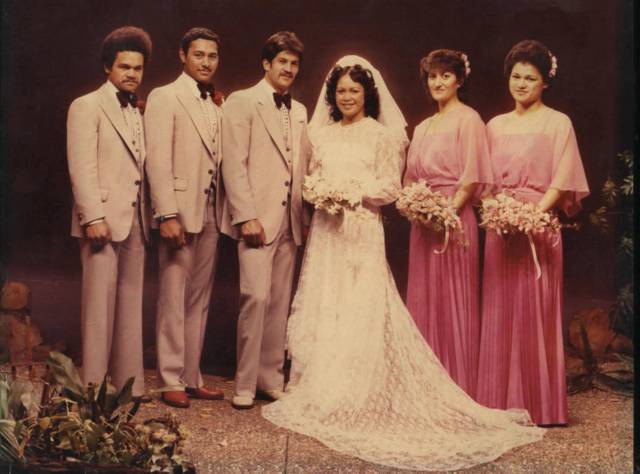
I don't really recall much about the day Katarina and I first met Chriss in 1980. It was the annual Tuatua Netball Competition in Kaitaia and she was playing in one of the visiting Auckland teams - I think it was Reckitt & Colmans where she and Bo both worked. Anyway, I was in the heyday of my vanity (no glasses), poverty (no contacts) and delinquency (frequently tipsy), so you could say I was blind drunk. Whatever - I don't remember meeting her, but Katarina does. She reckons that Bo introduced Chriss to her as the woman he was going to marry, and he did just that on 26th Septmber 1981. By then we'd all come to know and love the short, pretty and fiery Cook Island, town-girl very much and I was honoured to be one of their bridesmaids.

Bo and Chriss were married for just under 20 years and then she died, leaving us all in total shock and grief. In the Temple we do work related to the eternal family and this weekend I’ve been reminded that death can’t break a family. It’s an eternal thing and what we call death is only a temporary separation, not a permanent break. We all have faith that this is true, but I tell you - as a family we've never experienced anything like the wound of her death. We don't fear death - we just miss Chriss. Hers was the first death in our generation of the family and with it, as happened with the birth of the first of our children, so we began to move into another life era - that of dying. Bo said to us all not long after Chriss died, "Treasure every moment of your life together." I add to that my own advice - live life to make you worthy of being reunited forever with the ones you love and take nothing for granted. Love can come again, with all its baggage - both gory and glorious, but it should never ever be taken for granted.

Uncle Laurie was the first death-separation I remember and Bo never knew him in this life. Will they recognise each other when they meet? I’m sure they will. Our Chriss left us on July 7th 2001 and joined uncle Laurie. I wonder if he and she talk about his namesake? I’m sure they do. In the meantime it falls to Bo to live the life he has as best he can. Does he have what it takes to live it well until it is done? I know he does.

Elton John once wrote a song that has the lines,

"Who lived here?
He must have been a gardener that cared a lot,
Who weeded out the tares and grew a good crop,
And we are so amazed,
We're crippled and we're dazed,
A gardener like that one,
No-one can replace."

The fruit of Bo and Chriss "garden" is in their three sons. It's a good fruit brother. And that reminds me - I must remember to get that metal rake for Dougie.